Finding products to sell is relatively easy. Finding products that can be sourced reliably, delivered at a reasonable cost and reordered when they start selling is much more difficult.
For Amazon, eBay, Allegro, eMAG, Kaufland Marketplace and independent online stores, choosing a supplier affects much more than the purchase price. Retailers also need to consider minimum order quantities, delivery costs, stock availability, product documentation, packaging, lead times and the amount of capital tied up in inventory.
So where can you buy products to resell, and how should you choose a wholesale supplier in Europe?
This guide answers some of the most common sourcing questions for online retailers and marketplace sellers.
Where can I buy products to resell in Europe?
There are several common ways to source products for resale:
- manufacturers;
- European wholesalers and importers;
- wholesale marketplaces and B2B directories;
- distributors;
- direct importing from countries outside the EU;
- trade fairs and industry events.
There is no single sourcing method that works for every business.
Buying directly from a manufacturer can make sense when you already know which products you can sell in significant volumes. However, manufacturers may require larger minimum orders, and sourcing directly from overseas can involve longer lead times, freight arrangements, customs procedures and greater inventory commitments.
European wholesalers and importers can be particularly useful when flexibility and speed are important.
Products that have already been imported and are physically stocked in Europe can usually be ordered without waiting for a new production and international shipping cycle. Depending on the wholesaler, retailers may also be able to combine different products in the same order rather than purchasing a large quantity of a single SKU.
Businesses considering both options should compare the total sourcing cost, not simply the factory price.
Read also: Wholesale vs Importing Directly from China: Which Is Better for Your Business?
Where can I find wholesale suppliers in Europe?
A good supplier search should use several channels rather than relying on the first company found through Google.
Potential suppliers can be discovered through B2B wholesale marketplaces, business directories, trade fairs, industry associations, manufacturers, specialist wholesalers, importers and search engines.
Search queries can also become more specific depending on your requirements. Instead of searching only for “wholesaler Europe,” try combinations such as:
- kitchen appliance wholesaler Europe;
- wholesale tools supplier EU;
- home and garden wholesaler Europe;
- European wholesaler for online retailers;
- wholesale products for marketplace sellers;
- EU stock wholesale supplier;
- mixed pallet wholesaler Europe.
Finding a company, however, is only the beginning.
What should I check before buying from a wholesaler?
Before placing a significant order, verify the supplier as you would any other important business partner.
Check the company’s legal details and VAT information. Look at where its stock is actually located and whether the products shown online are genuinely available.
You should also understand:
Minimum order requirements. Do you need to buy a full carton, pallet or large quantity of every SKU?
Stock information. Can you see what is currently available, or must availability be confirmed manually?
Product documentation. What product information and relevant documentation are available?
Delivery conditions. From where will the goods be shipped, and how will transportation be calculated?
Payment conditions. When and how is payment required?
Product variety. Can you source several categories from the same supplier?
Reordering. If a product performs well, can you return and order a larger quantity?
Price matters, but reliability, stock availability and logistics can have just as much influence on the profitability of an online retail business.
For a more detailed supplier checklist, see How to Choose a Reliable Wholesale Supplier in Europe.
Where can I buy products to resell on Amazon?
Amazon sellers should evaluate products differently from traditional retailers.
A low wholesale price does not automatically mean a product will be profitable on Amazon.
Before purchasing inventory, consider:
Demand and competition. Is there sufficient demand, and how many sellers already compete for the same type of product?
Marketplace fees. Calculate selling fees and any fulfillment-related costs before determining your potential margin.
Product size and weight. A bulky low-value product can look attractive at wholesale price but become considerably less attractive once fulfillment and transportation costs are included.
Selling price and margin. Calculate your margin after marketplace fees, shipping, VAT where applicable, returns and other operational costs.
Product information and documentation. Determine what information, labeling and documentation are required for the particular product and market.
Marketplace restrictions. Some categories and products may be subject to additional requirements or selling restrictions.
Returns. Include an expected level of returns and customer service costs in your calculations.
Test before scaling
One of the biggest sourcing mistakes is ordering a large quantity simply because the unit price becomes more attractive.
Imagine you are considering five new products.
Instead of investing most of your purchasing budget into 500 units of one untested product, it may be more useful to test several products in smaller quantities.
You can then compare:
sales velocity → advertising cost → conversion → returns → actual margin
and increase the order quantity of products that demonstrate real demand.
This approach does not eliminate risk, but it can reduce the amount of capital committed to an unproven product.
Read: How Mixed Wholesale Orders Help Retailers Test New Products
Where can I buy products to resell on eBay?
eBay sellers often work with particularly broad assortments, making flexible sourcing valuable.
Depending on the seller’s strategy, opportunities may include evergreen products, niche items, seasonal products, new arrivals and products for which demand varies considerably throughout the year.
When sourcing for eBay, consider whether a supplier allows you to:
- test smaller quantities;
- purchase several different SKUs;
- regularly check current availability;
- reorder successful products;
- discover new products without changing suppliers.
For businesses selling hundreds of different listings, assortment flexibility can sometimes be more valuable than obtaining the absolute lowest unit price on a single SKU.
Where can I buy products to sell on Allegro?
For Allegro sellers, sourcing products already located in Poland or elsewhere in the EU can provide practical advantages, particularly when replenishment speed matters.
Before selecting products, compare the wholesale cost with the actual competitive environment on Allegro.
Check the current selling-price range, number of competing offers, delivery expectations, marketplace costs and likely margin.
Also consider how easily the product can be replenished.
A product can become a successful listing, but if the next shipment takes several months to arrive, maintaining sales becomes difficult. Access to stock located closer to the target market can make replenishment more manageable.
For Polish marketplace sellers, working with a Polish or European wholesaler can therefore be worth comparing with direct overseas importing even when the overseas factory price initially appears lower.
Where can I source products for eMAG?
The same basic sourcing principles apply to sellers using eMAG, but the economics should be calculated for the specific market where the products will be sold.
A Romanian online retailer, for example, should not evaluate a wholesale offer using only the supplier’s unit price.
Consider:
wholesale price + transport + marketplace costs + local selling price + expected returns + VAT/tax implications applicable to your business.
Transportation is particularly important.
If you purchase many low-value products, transport costs distributed across the order can significantly affect the real cost per unit. Combining several products into a larger shipment may sometimes produce better logistics economics than repeatedly sending very small orders.
This is why retailers should calculate landed cost, rather than comparing suppliers solely by catalogue price.
Where can I buy wholesale products for Kaufland Marketplace?
Kaufland Marketplace sellers operating across European markets may need to manage an assortment for more than one country.
In this situation, supplier consolidation can become useful.
Suppose an online retailer sells:
- small kitchen appliances;
- cookware;
- DIY products;
- garden equipment;
- household products;
- seasonal products.
Buying every category from a separate supplier means managing multiple relationships, payments, deliveries and minimum-order requirements.
A multi-category wholesaler can potentially simplify this process by allowing different product groups to be combined into fewer purchasing operations.
However, sellers should still evaluate each product individually. A supplier being convenient does not automatically make every product suitable for every marketplace.
Do I need to buy a full pallet from a wholesaler?
Not always.
Wholesale ordering can take several forms depending on the supplier and product:
| Order type | Common use |
| Individual products / mixed cartons | Testing products and building a varied assortment |
| Mixed pallet | Combining multiple SKUs in a larger order |
| Full pallet | Replenishing products with proven demand |
| Multiple pallets | Scaling established products |
| Truckload | High-volume distribution |
| Container sourcing | Large-volume or individual sourcing requirements |
For a growing retailer, these stages can form a natural progression.
You might start by testing several products, identify the strongest performers, reorder them in larger quantities and eventually move selected products to pallet-level purchasing.
The important point is that your purchasing model should follow proven demand, rather than forcing your business to buy large volumes before you know what customers actually want.
Read more: Cartons, Mixed Pallets or Truckloads: Which Wholesale Order Is Right for Your Business?
Can I buy products from several categories in one wholesale order?
Yes, if your supplier supports mixed wholesale orders.
This can be particularly useful for online stores that do not specialize exclusively in one category.
For example, a retailer preparing a new assortment could potentially combine:
Kitchen: air fryers, mixers and cookware
DIY & Garden: cordless tools, blowers and sprayers
Home: cleaning equipment and seasonal heating products
Electronics: selected consumer electronics
Instead of making four independent purchases from four suppliers, products from several categories can be consolidated into one wholesale order when the supplier’s ordering model allows it.
There are two potential benefits.
First, you can diversify product risk. Your purchasing budget is distributed across several products rather than concentrated in one SKU.
Second, consolidating products can simplify logistics and purchasing administration.
This does not mean retailers should randomly add products from different categories. Each SKU should still have a clear reason for being in the assortment.
How should I test a new wholesale product?
A simple product-testing process can look like this:
1. Research
Check marketplace demand, competition, selling prices and similar products.
2. Calculate
Estimate the complete cost of selling the product, including purchase price, transportation, marketplace fees and other relevant costs.
3. Start with a controlled quantity
Avoid committing excessive capital before you have sales data.
4. Measure
Track sales velocity, conversion, returns, advertising costs and actual margin.
5. Reorder successful products
Products demonstrating consistent demand can justify larger purchases.
6. Remove or reduce weak performers
Capital tied up in slow-moving inventory cannot be invested in better-performing products.
This creates a straightforward cycle:
Test → Measure → Reorder → Scale
For a broader assortment strategy, read How to Build a Profitable Wholesale Product Range for an Online Store.
Should I choose evergreen or seasonal products?
Most retailers benefit from understanding the role of both.
Evergreen products can generate demand throughout much of the year. Examples can include household products, kitchen equipment, tools and cleaning products.
Seasonal products may generate considerably stronger demand during specific periods but require more careful purchasing timing.
Garden equipment may become more relevant before and during the gardening season, while heating products naturally become more important as colder months approach.
A balanced assortment can combine a stable base of evergreen products with selected seasonal opportunities.
The important consideration is timing.
Buying seasonal inventory too late can leave very little selling window. Buying too much can leave the retailer holding stock until the following season.
Is the cheapest wholesaler always the best option?
No. Comparing only the unit price can produce misleading conclusions.
Consider two hypothetical suppliers.
Supplier A offers a product for €10 but requires a large minimum quantity and longer replenishment cycle.
Supplier B offers it for €11, holds stock in Europe and allows you to purchase a smaller initial quantity.
Supplier A appears cheaper per unit.
But if the product performs poorly, the retailer may have substantially more capital trapped in inventory.
Conversely, once demand has been proven and volumes become large enough, a different sourcing model may become more economical.
The right question therefore isn’t simply:
“Which supplier has the lowest price?”
It is:
“Which sourcing model gives my business the best combination of cost, risk, availability and scalability at its current stage?”
European wholesale sourcing with Adamanta
Once you understand what you want to test and how much you want to purchase, the next step is finding a sourcing model that supports it.
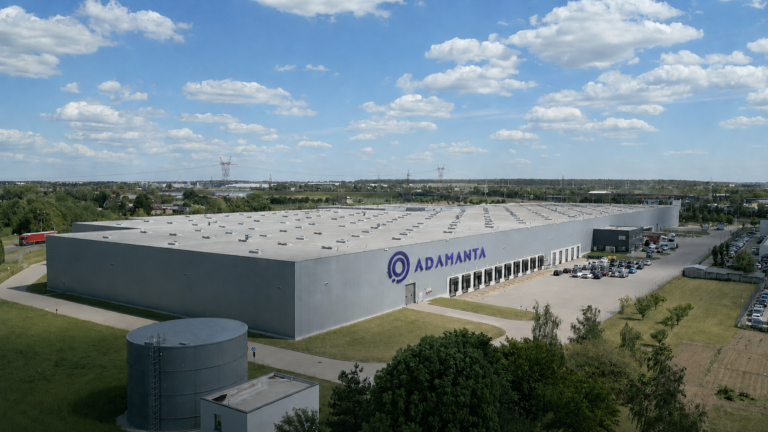
Adamanta is a European B2B importer and wholesaler supplying retailers, online stores, marketplace sellers and distributors with products across multiple categories.
Products are stocked in our warehouse in Poland, and business customers can browse the available assortment and current stock through our online B2B platform.
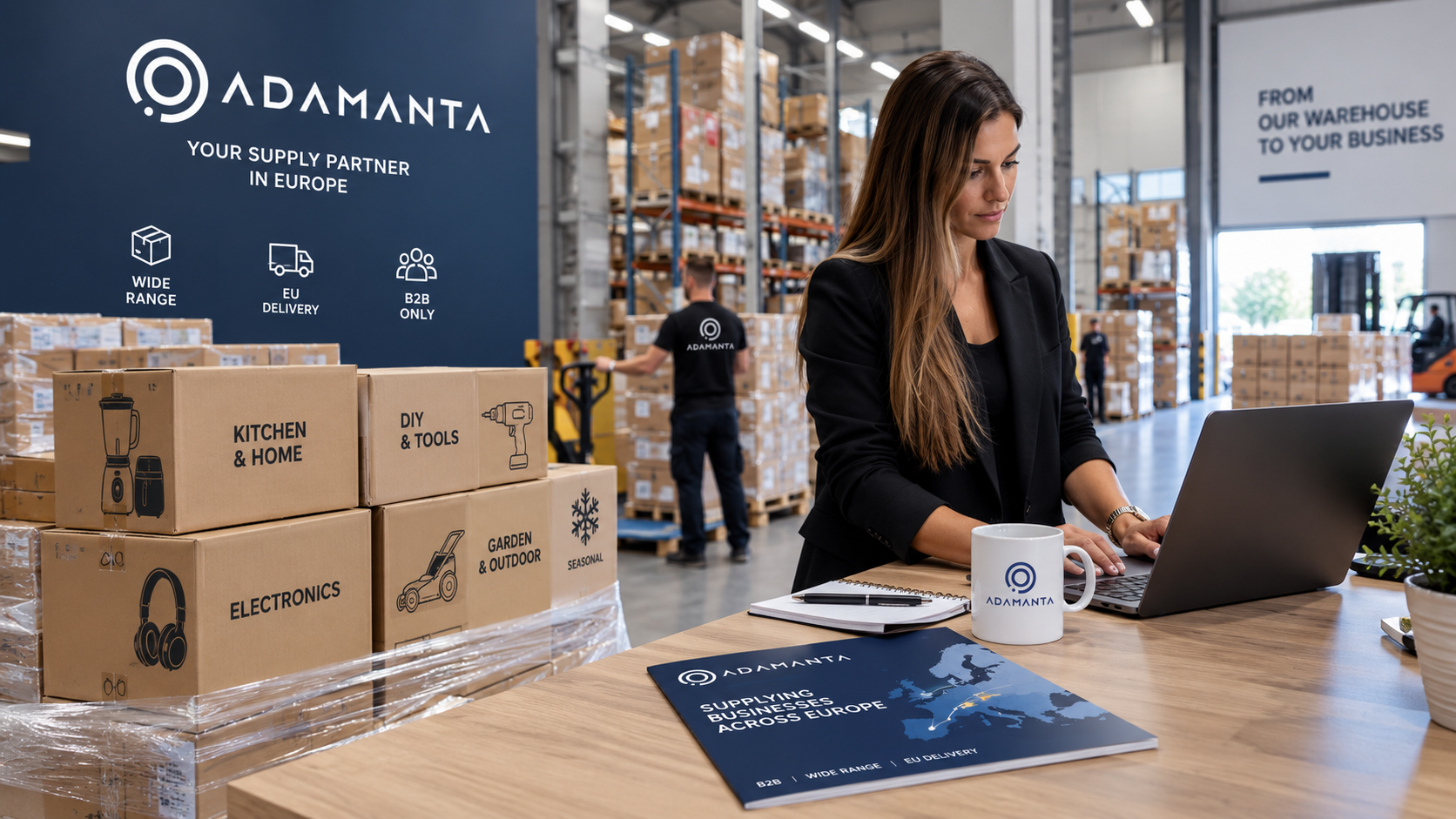
The catalogue includes categories such as Kitchen, Home, DIY & Tools, Garden, Electronics, Automotive, Seasonal products and more.
Rather than requiring a retailer to build an assortment around one product category, Adamanta allows customers to create mixed wholesale orders.
This means an online retailer can combine different products and categories within an order and use smaller initial quantities to evaluate demand.
If certain products perform well, subsequent orders can be increased.
This model can support businesses through different purchasing stages:
product testing → mixed orders → larger quantities → pallets → multiple pallets → truckload and individual volume requirements.
For larger orders, truckload and other volume arrangements can be coordinated after the order is submitted.
How does ordering from Adamanta work?
The process is designed so that B2B customers can build the order themselves online.
Register to access the wholesale platform.
2. Browse the product catalogue
Compare products across available categories and check current stock.
3. Build your order
Choose the products and quantities appropriate for your business. Products from different categories can be combined in the same order.
4. Submit the order online
You do not need to arrange transport before placing the order.
5. Receive the pro-forma invoice and transport quotation
After the order is submitted, the order is processed and transportation is calculated.
6. Complete payment
Orders are processed on a pro-forma basis.
7. Shipment
The goods are prepared for dispatch from Poland to the agreed destination.
For larger requirements, the appropriate volume and logistics arrangements can be coordinated based on the submitted order.
Looking for products to resell?
Whether you sell through your own online store, Amazon, eBay, Allegro, eMAG, Kaufland Marketplace or other sales channels, your first wholesale purchase does not have to be a bet on a single product.
Explore Adamanta’s wholesale catalogue, compare products across different categories and build an order around the assortment you actually want to test.
Start with selected products, measure real demand and increase quantities when you know what works for your business.
Frequently Asked Questions
Can I buy wholesale products in Europe without ordering a full pallet?
It depends on the supplier. Some wholesalers require cartons, pallets or other minimum quantities, while others support mixed orders. For businesses testing new products, the ability to combine different SKUs can reduce the amount of inventory committed to a single product.
Can I combine different products in one wholesale order?
Yes, when the wholesaler supports mixed ordering. At Adamanta, B2B customers can combine products from different available categories in one order, making it possible to build a broader assortment rather than purchasing only one SKU.
Where can I buy products to resell on Amazon?
Products can be sourced from manufacturers, importers, distributors and European wholesalers. Before buying for Amazon, evaluate marketplace restrictions, demand, competition, fees, product dimensions, fulfillment costs, documentation and expected margin. Sellers are responsible for ensuring that products and offers meet the requirements applicable to their marketplace and category.
Where can I find European wholesalers for eBay sellers?
European wholesalers can be found through search engines, B2B directories, wholesale marketplaces, trade fairs and industry networks. Look beyond catalogue price and verify stock location, company information, minimum quantities, transport conditions and the possibility of reordering successful products.
Where can I source products for Allegro?
Allegro sellers can source from Polish and European wholesalers, importers, distributors or directly from manufacturers. For fast-moving products, stock availability and replenishment speed can be particularly important alongside wholesale price.
Can a European wholesaler deliver to other EU countries?
Many European wholesalers provide cross-border B2B delivery, but available destinations, costs and delivery methods vary. Adamanta supplies customers across the EU, with transportation calculated according to the order and destination.
Is it better to buy from a European wholesaler or import directly from China?
Neither model is automatically better. Direct importing can become attractive at sufficient volumes, while European wholesale sourcing can offer advantages such as shorter supply chains, smaller purchasing commitments and easier access to mixed stock. Businesses should compare total landed cost, lead time, inventory risk and operational requirements rather than unit price alone.
How do I know whether a European wholesale supplier is reliable?
Verify the company’s registration and VAT details, physical location, stock information, payment conditions, product information and delivery process. For larger purchases, establish exactly where the goods are located and what happens after the order is submitted.