For retailers, distributors and e-commerce businesses, sourcing products is one of the most important decisions affecting profitability and growth.
One of the most common choices is whether to import products directly from manufacturers in China or buy from a European wholesale supplier and importer.
At first glance, importing directly can appear to be the cheaper solution. Factory prices can be attractive, particularly when purchasing large quantities. But the product price is only one part of the real cost of importing.
International freight, customs procedures, quality control, minimum order quantities, storage, compliance, long lead times and capital tied up in inventory can significantly change the final calculation.
Buying from an established European importer and B2B wholesaler offers a different model: products have already been sourced and imported into Europe, allowing retailers to purchase according to their actual business needs.
So which model makes more sense?
Let’s compare them.
Direct Importing from China: How Does It Work?
Direct importing means purchasing products directly from a manufacturer or supplier outside Europe and taking responsibility for bringing those products into your market.
For businesses purchasing large quantities of proven products, this can be an effective sourcing strategy.
However, importing involves much more than finding a manufacturer and negotiating a factory price.
The buyer may need to manage:
- Supplier verification
- Product samples
- Price negotiations
- Minimum order quantities
- Production schedules
- Quality inspections
- Product documentation and compliance
- International transportation
- Customs clearance
- Import duties and taxes
- Insurance
- Warehousing
- Defective or damaged products
- Currency fluctuations
- Communication across different time zones
Each additional step requires time, experience and resources.
Advantages of Importing Directly from China
Direct importing has genuine advantages and can be the right solution for certain businesses.
Potentially Lower Unit Prices
Purchasing directly from a manufacturer can provide a lower initial unit price, particularly when ordering very large quantities.
For established distributors selling thousands of units of the same proven product, the difference can be significant.
Product Customization
Manufacturers may provide opportunities to customize packaging, colors, specifications and branding.
This can be useful for businesses developing their own private-label products.
Greater Control Over Production
Large buyers can negotiate directly with manufacturers regarding specifications, production quantities, packaging and future orders.
For companies with experienced purchasing and import teams, this provides additional control over the supply chain.
What Are the Disadvantages of Direct Importing?
The factory price should never be considered in isolation.
High Minimum Order Quantities
Manufacturers often require substantial minimum order quantities.
Instead of purchasing a few cartons to test demand, you may need to commit to hundreds or thousands of units.
This means investing significant capital before knowing how quickly the product will sell.
Long Lead Times
Direct importing may involve manufacturing time followed by international transportation and customs clearance.
If a product suddenly starts selling faster than expected, replenishing it quickly can be difficult.
For seasonal goods, arriving several weeks late can mean missing the most important sales period.
Capital Tied Up in Inventory
Large orders require substantial upfront investment.
Money invested in inventory cannot be used for marketing, new product opportunities or other parts of your business until those products are sold.
Quality Control Becomes Your Responsibility
A good product sample does not necessarily guarantee that every unit in a large production batch will meet the same standard.
Importers therefore need reliable quality-control procedures and clear agreements with manufacturers.
Discovering a problem after thousands of units have already arrived can be expensive.
Import and Customs Administration
Direct importing also means managing documentation, transportation, customs procedures and other import responsibilities.
Depending on the type of product, additional European documentation and regulatory requirements may apply.
Greater Inventory Risk
Imagine ordering 2,000 units because the factory price looks excellent.
If only 300 units sell quickly, the remaining stock becomes a business cost.
You may face:
- Capital locked in inventory
- Storage costs
- Unsold products
- Price reductions
- Changing market demand
- Product obsolescence
This is why the cheapest unit price does not necessarily mean the lowest total business cost.
Buying from a European Importer and Wholesaler
The alternative is purchasing products from a company that has already handled much of the import process.
The European importer sources products, organizes international transportation and brings inventory into Europe before offering it to retailers and distributors.
Products can therefore already be physically available in a European warehouse when the customer places an order.
For the buyer, this significantly simplifies purchasing.
Instead of managing an international supply chain, the business can concentrate on selecting products, selling them and replenishing successful stock.
Is Buying from a European Wholesaler Really More Expensive?
Not necessarily.
The unit price may sometimes be higher than the price quoted directly by a factory, but comparing only these two numbers can be misleading.
The true cost of direct importing may include:
Product cost + freight + customs + quality control + administration + warehousing + financing + damaged goods + unsold inventory + employee time.
There is also the financial risk associated with committing to large quantities.
A European wholesale supplier has already absorbed many of these processes before the retailer places an order.
For many businesses, paying slightly more per unit can therefore result in lower overall risk and a more efficient purchasing model.
Lower Minimum Orders Mean Lower Financial Risk
One of the biggest advantages of purchasing wholesale within Europe is flexibility.
Instead of investing most of your purchasing budget into one product, you can spread it across different products and categories.
This allows businesses to create a more diversified assortment while reducing dependence on the success of one large import order.
Test Products Before Scaling
Predicting demand is difficult.
A product that looks promising may perform differently once it reaches the market.
Buying through a European wholesaler allows retailers to test products before committing to significantly larger quantities.
A more flexible purchasing strategy becomes possible:
Test → Sell → Analyze → Reorder → Scale
instead of:
Predict → Import Large Quantity → Wait → Hope It Sells
This is particularly valuable for online retailers and marketplace sellers, where trends and customer demand can change quickly.
Faster Stock Replenishment
When inventory is already located in Europe, successful products can be replenished considerably faster than products requiring a new production and overseas shipping cycle.
Fast replenishment is particularly valuable during:
- Seasonal peaks
- Christmas sales
- Summer demand
- Promotional campaigns
- Marketplace sales spikes
- Unexpected product trends
Sometimes being able to restock a bestseller quickly is more profitable than saving a small amount on the original unit price.
More Products from Fewer Suppliers
Direct sourcing often requires relationships with multiple manufacturers.
A retailer selling electronics, home appliances, tools, garden products and automotive accessories may otherwise need to coordinate several factories, payments and shipments.
A multi-category European wholesaler allows businesses to consolidate purchasing and access different types of products through one B2B partner.
This reduces administrative complexity and makes it easier to build and test a broader product portfolio.
Direct Import vs. European Wholesaler: Quick Comparison
| Factor | Direct Import from China | European Importer / Wholesaler |
|---|---|---|
| Unit purchase price | Often lower at high volumes | May be higher |
| Minimum quantities | Often higher | More flexible |
| Initial investment | Higher | Lower and scalable |
| Product testing | More difficult | Easier |
| Delivery time | Longer | Faster from European stock |
| International freight | Buyer manages it | Already managed |
| Customs/import process | Buyer manages it | Already handled |
| Quality control | Buyer must organize it | Importer manages sourcing/QC |
| Inventory risk | Higher | Potentially lower |
| Product variety | Often factory-specific | Multiple categories possible |
| Replenishment | Longer cycle | Faster |
| Operational workload | Higher | Lower |
| Custom production | Greater possibilities | Possible through sourcing arrangements |
| Best suited for | Proven, very high-volume products | Retailers, distributors and e-commerce businesses |
When Does Direct Importing Make Sense?
Direct importing can be an excellent solution when:
- You already know a product sells consistently
- You require very large quantities
- You have sufficient working capital
- You have import and sourcing experience
- You can manage quality control
- You have sufficient warehouse capacity
- Longer replenishment cycles are acceptable
- You require custom production or private labeling
At sufficient scale, direct sourcing can provide important cost advantages.
When Is Buying from a European Importer Better?
A European wholesale supplier may be the better solution when:
- You want to test new products
- You want access to multiple product categories
- You don’t want to commit to large quantities immediately
- You need stock quickly
- You want to reduce inventory risk
- You don’t want to manage international importing yourself
- You need regular replenishment
- You sell seasonal or trending products
- You operate an online store or marketplace business
- You want to focus your resources on sales rather than import logistics
For many retailers, the main advantages are therefore speed, flexibility, simplicity and reduced risk.
You Don’t Necessarily Have to Choose One Model
There is also a third possibility: combine both approaches.
Large businesses may import proven, high-volume products directly while using European wholesale suppliers for new products, seasonal opportunities, additional categories and fast stock replenishment.
The right sourcing strategy depends on volume, capital, risk tolerance and how quickly the business needs to react to market demand.
Adamanta: The Possibilities of an Importer with the Flexibility of a European Wholesaler
This is where the Adamanta model becomes particularly useful for retailers and distributors.
Adamanta is both a European importer and B2B wholesaler.
We work directly with manufacturers and manage much of the complex work that takes place before products become available to our customers — from sourcing and product selection to international transportation, quality control, import logistics and warehousing.
Our customers therefore gain access to imported products and large-volume purchasing possibilities without having to build and manage the entire international supply chain themselves.
One Partner – Different Ways to Buy
Businesses do not all purchase in the same way.
With Adamanta, cooperation can develop according to your actual requirements.
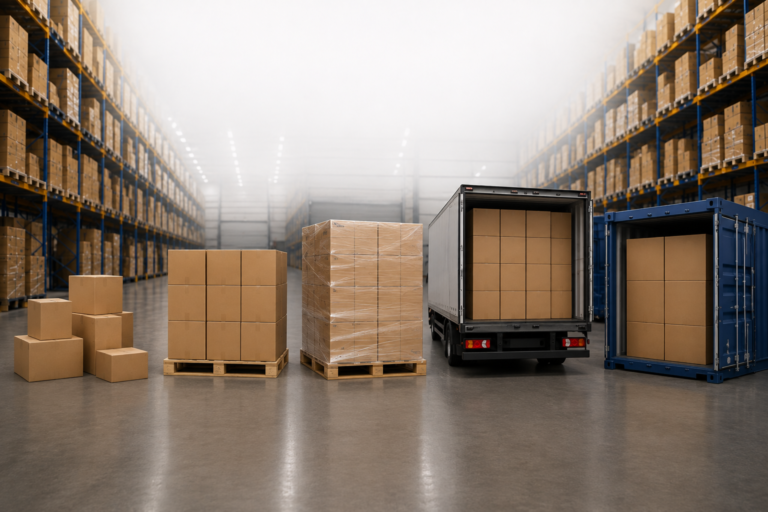
Depending on the product and project, customers can purchase:
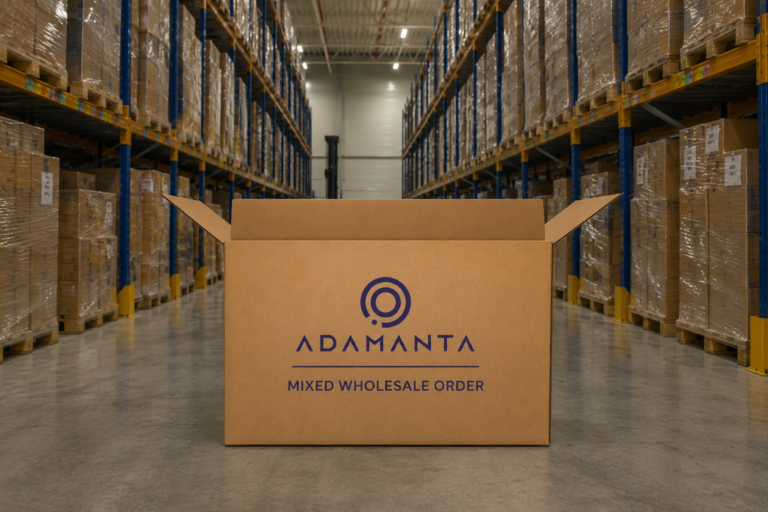
- Mixed wholesale orders
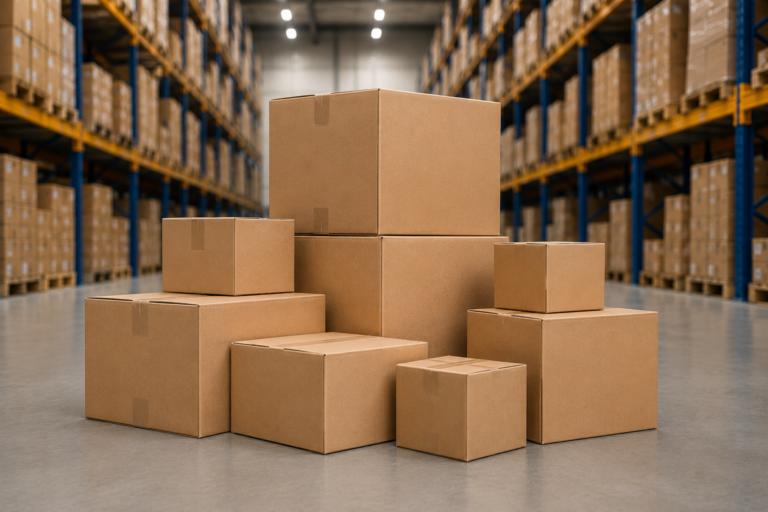
- Individual cartons
- Larger quantities of selected products
- Full pallets
- Full truck quantities
- Large-volume orders
- Container quantities
- Individually sourced products for selected projects and long-term cooperation
This gives businesses the possibility to start smaller, identify what sells and increase purchasing volumes as demand grows.
You don’t have to choose between the flexibility of a wholesaler and the possibilities of an importer.
With Adamanta, you can have both.
Thousands of Products Through One European B2B Supplier
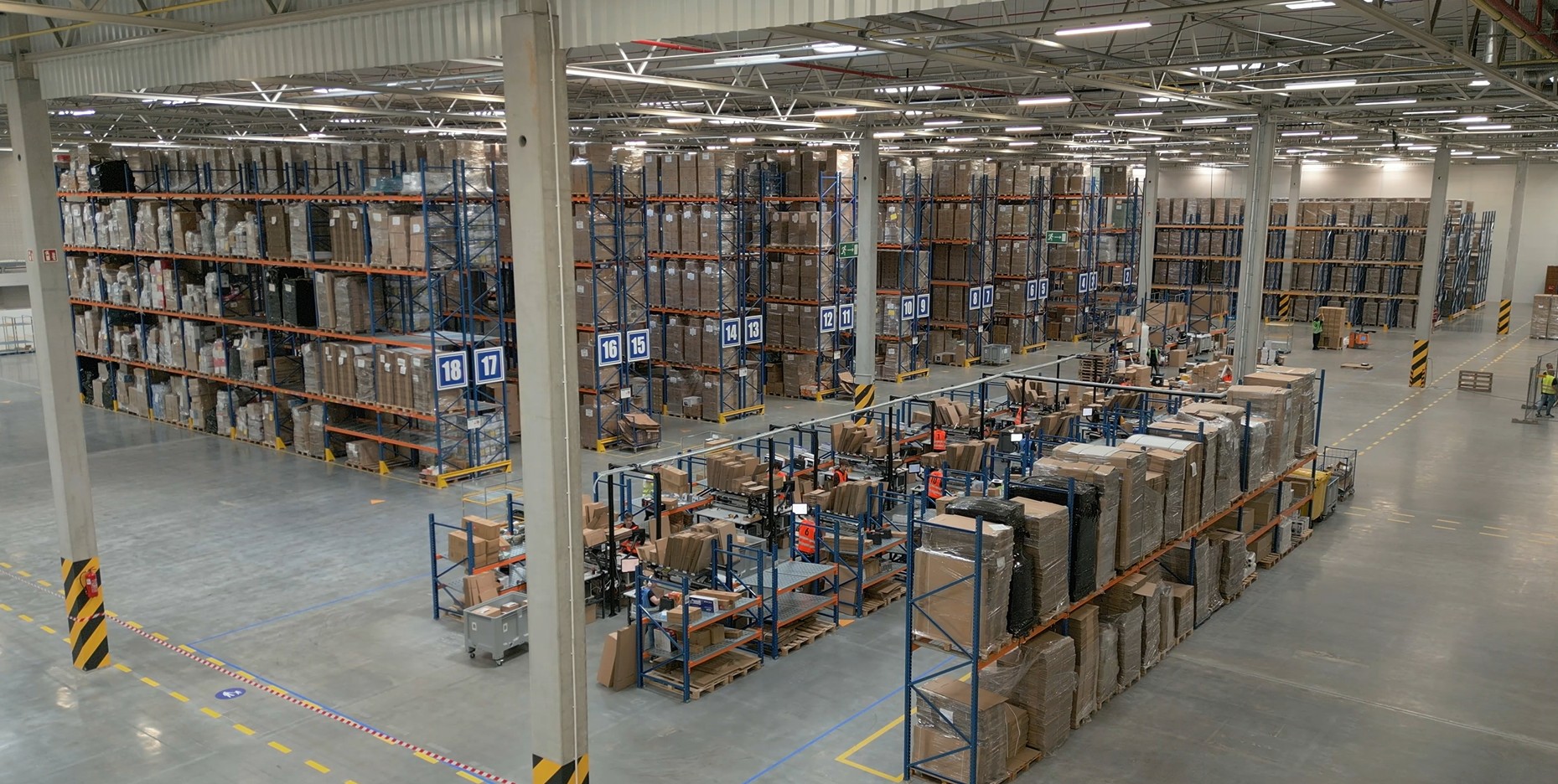
From our 20,000 m² logistics center in Poland, Adamanta supplies thousands of wholesale products across multiple categories, including:
- Consumer electronics and gadgets
- DIY tools and power equipment
- Cleaning equipment
- Home appliances
- Garden and outdoor products
- Automotive accessories
- Home & Living
- Fitness products
- Lighting
- Seasonal products
- Pet products
This allows retailers and distributors to build a broader assortment without establishing separate sourcing relationships for every product category.
Our assortment is continuously developed according to market demand, seasonal opportunities and emerging product trends.
Need a Product That Is Not in Our Catalogue?
Working with Adamanta is not necessarily limited to products currently available in our online catalogue.
For selected projects and larger-volume requirements, our team can discuss individual product sourcing and import opportunities.
This can be particularly valuable for distributors, retail chains and businesses searching for specific products or planning larger purchasing volumes.
Instead of building a new supplier and import network from scratch, you can cooperate with an importer that already has established sourcing and logistics processes.
Scale from Cartons to Pallets, Trucks and Containers
Your purchasing requirements today may be very different from what your business needs in the future.
A retailer may start by testing several products, move to regular pallet orders and eventually require truck or container quantities.
Adamanta is structured to support this development within one B2B relationship.
That means your supplier does not have to change simply because your business grows.
Focus on Selling – We Handle the Supply Side
Managing manufacturers, international transportation, imports, quality control, inventory and sourcing takes time.
Adamanta handles much of this work before products become available to our customers.
Our partners can therefore concentrate more of their resources on what generates revenue:
choosing the right products, reaching customers and growing sales.
Whether you operate an online store, retail chain, marketplace business, wholesale company or distribution network, our objective is to make sourcing products for the European market simpler, faster and more scalable.
Frequently Asked Questions
Is importing directly from China always cheaper?
No. Factory prices can be lower, particularly for large orders, but businesses should compare the total landed and operational cost rather than only the product price. Transportation, customs, inspections, warehousing, financing, administration and inventory risk can all affect the real cost.
Why buy from a European importer instead?
For many businesses, the main advantages are faster product availability, lower purchasing commitments, easier product testing, simplified logistics and reduced inventory risk.
Can I test products before ordering larger quantities?
Purchasing from a wholesaler can make this considerably easier because businesses can start with smaller quantities and scale orders according to actual sales performance.
Can I purchase different categories in one wholesale order?
A multi-category wholesaler such as Adamanta allows businesses to source different types of products through one supplier, making it easier to diversify their assortment.
Can Adamanta handle larger orders?
Yes. Cooperation can range from mixed wholesale orders and pallets to truck quantities, containers and individually discussed large-volume projects.
Can Adamanta source products that are not currently in the catalogue?
For selected projects and larger-volume requirements, individual sourcing opportunities can be discussed directly with our team.
Which Sourcing Model Is Right for Your Business?
There is no universal answer.
Direct importing can provide excellent opportunities for experienced businesses purchasing very large quantities of proven products.
European wholesale purchasing provides a different advantage: flexibility, speed, lower inventory exposure and significantly less operational complexity.
The most important question is therefore not simply:
“Where can I find the lowest unit price?”
A better question is:
“Which sourcing model gives my business the best combination of margin, speed, flexibility and risk?”
For many European retailers, distributors and e-commerce businesses, working with an established importer and wholesaler provides an effective balance between these factors.
Looking for a European Wholesale and Import Partner?
You don’t need to manage every stage of direct importing yourself to access imported products, competitive B2B pricing and large-volume purchasing possibilities.
With Adamanta, you can start with a mixed wholesale order, purchase pallets or truck quantities, scale to larger volumes, or discuss individual sourcing and container cooperation as your business develops.
Benefit from an established European importer, thousands of wholesale products, stock located in Poland and B2B logistics serving customers across Europe.
Start Cooperation with Adamanta
Explore Our Wholesale Products →
Register for a Free B2B Account →
Whether you are testing your first wholesale products or looking for a long-term import and distribution partner, Adamanta gives your business the flexibility to start, test, scale and grow.