Building a profitable online store is not simply about finding products with the lowest wholesale price.
A strong product range needs the right balance between consistent demand, attractive margins, manageable competition, logistics costs and opportunities for repeat or complementary purchases.
For retailers and e-commerce sellers, one of the biggest mistakes is investing too much stock in products before knowing how customers will respond. Another is building a catalogue from unrelated products without considering seasonality, shipping costs or how different categories can support each other.
A better approach is to build the assortment gradually: create a stable core, test new opportunities and increase purchasing volumes based on actual sales.
Here are some of the most important factors to consider.
1. Start With a Core of Evergreen Products
Evergreen products are products that can generate demand throughout most or all of the year.
They provide stability to an online store because sales are less dependent on a particular season.
Depending on your target customer, examples can include:
- small home appliances,
- cleaning equipment,
- DIY tools,
- automotive accessories,
- electronics and accessories,
- home & living products,
- pet products.
For example, products such as cordless tools, cleaning equipment or kitchen appliances can remain relevant throughout the year.
This does not mean every evergreen product will automatically become a bestseller. Competition, pricing and customer demand still need to be evaluated.
The objective is to create a stable foundation for your product range before relying heavily on seasonal opportunities.
2. Add Seasonal Products for Additional Sales Opportunities
Seasonal products work differently.
Demand can increase significantly during a relatively short period, making them attractive for retailers that prepare inventory at the right time.
Spring and summer may create stronger demand for products such as:
- garden tools,
- outdoor lighting,
- camping products,
- cooling equipment,
- BBQ products,
- outdoor accessories.
Autumn and winter can shift demand toward:
A retailer selling only seasonal products may experience significant fluctuations throughout the year.
A retailer selling only evergreen products, however, may miss some of the strongest short-term sales opportunities.
For many online stores, the better strategy is therefore:
Evergreen core + seasonal opportunities + continuously tested new products.
3. Test Products Before Increasing Purchasing Volume
Finding an interesting product does not mean you immediately need hundreds or thousands of units.
Product images, marketplace trends and competitor sales can indicate potential, but the most valuable information comes from your own sales data.
A retailer can start with smaller quantities of several products and monitor:
- conversion rate,
- selling price,
- advertising cost,
- return rate,
- customer feedback,
- marketplace performance,
- speed of stock turnover.
Products that perform well can then be reordered in larger quantities.
Products that fail to generate sufficient demand can be removed without leaving the business with excessive inventory.
This is particularly useful when entering a completely new category.
For example, instead of investing heavily in one cordless garden tool, a retailer could test several products such as a mini chainsaw, grass trimmer, pressure washer and other cordless tools.
Actual sales then show where the next investment should go.
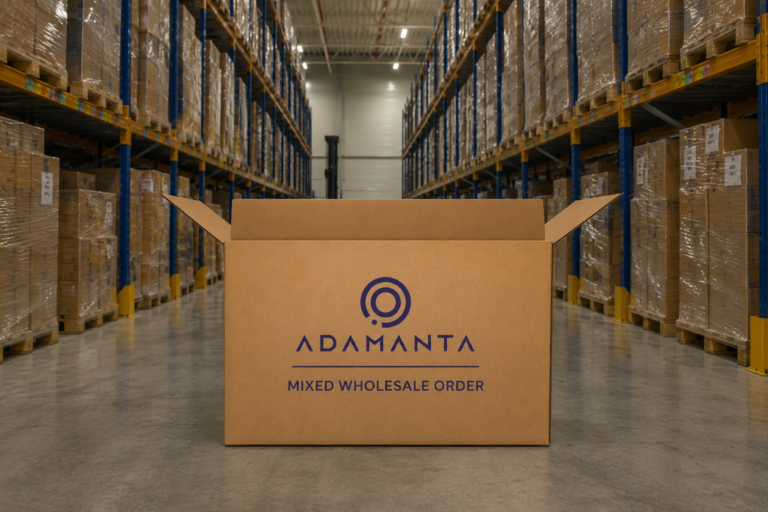
This is one reason why mixed wholesale orders can be valuable when developing an e-commerce assortment.
4. Build Complementary Product Categories
A profitable product range should not consist only of individual bestsellers.
Think about what the same customer may want to purchase before, together with or after buying the original product.
A store selling DIY and cordless tools, for example, can naturally expand into:
garden equipment → cleaning equipment → workshop products → automotive accessories.
A retailer focused on home products could combine:
kitchen appliances → cleaning equipment → heating and cooling → Home & Living.
An electronics seller might combine:
consumer electronics → smart devices → cameras → automotive electronics → lighting.
These connections make it easier to expand the assortment without completely changing the target customer.
They also create opportunities for cross-selling and larger basket values.
5. Consider Packaging Before Choosing a Product
A product can have an attractive purchase price and still be commercially difficult to sell online.
Packaging dimensions and weight directly affect logistics.
Imagine two products that both generate a €15 gross margin.
One fits inside a small parcel.
The other requires an oversized shipment.
The actual profitability of those products can be very different once storage, packaging, courier charges and returns are included.
Before adding a wholesale product to your catalogue, consider:
Product dimensions and weight – How expensive will individual B2C delivery be?
Retail packaging – Can the product be shipped safely in its existing packaging?
Damage risk – Is it fragile or particularly difficult to transport?
Storage efficiency – How many units can realistically be stored?
Wholesale transport efficiency – How many units fit into cartons and pallets?
For e-commerce businesses, these factors can be almost as important as the wholesale purchase price itself.
6. Think About Marketplace Suitability
A product that performs well in a physical retail store does not necessarily perform equally well on a marketplace.
If you sell through platforms such as Amazon, Allegro, eBay or other European marketplaces, evaluate products from the perspective of an online customer.
Consider:
- Is the benefit immediately understandable from the product image?
- Can the product be demonstrated effectively through photos or video?
- Is there sufficient margin after marketplace commissions?
- Is B2C shipping economical?
- Are similar products already heavily price-competitive?
- Can the product generate strong search demand?
- Is it likely to have a high return rate?
Products with a clear visual benefit can be particularly interesting for online sales.
For example, cordless tools, cleaning devices, cooling products and practical household gadgets can often be demonstrated effectively through lifestyle photography and short product videos.
The objective is not simply to find a product that looks interesting.
You need a product that works within the economics of your particular sales channel.
7. Use New Arrivals to Find Opportunities Before Your Competitors
An online store should not remain static.
Consumer demand changes, new product variations appear and existing categories evolve.
Regularly reviewing new wholesale arrivals gives retailers an opportunity to identify products before they become widely available across competing stores.
But new does not automatically mean profitable.
New products should normally enter the same testing process:
Discover → test → measure → reorder → scale.
If the product performs well, purchasing volume can gradually increase.
This approach allows an online retailer to remain active in new-product discovery without turning every new arrival into a large inventory risk.
8. Use Container Deliveries for Inventory Planning
Another useful signal is upcoming and recently received container stock.
For retailers working with a European importer, container deliveries can provide information about products entering the European warehouse in larger quantities.
This can be particularly useful for seasonal purchasing.
For example, a retailer preparing for the garden season may monitor incoming shipments of:
- grass trimmers,
- mini chainsaws,
- pressure washers,
- garden accessories,
- outdoor lighting.
A business preparing for colder months may instead focus on incoming heaters and other seasonal home products.
Knowing what stock is arriving can help retailers plan campaigns, prepare listings and organize purchasing before peak demand develops.
9. Don’t Build Your Entire Range Around One Bestseller
Finding a bestseller is excellent.
Becoming completely dependent on it creates risk.
Demand changes. Competitors lower prices. Advertising costs increase. Marketplace rankings change. Products sell out.
A stronger online retail business develops several sources of revenue.
For example, instead of depending entirely on cordless garden tools, an e-commerce retailer could build a portfolio around:
DIY tools + garden equipment + automotive accessories + cleaning equipment + selected seasonal products.
Not every category needs to contribute equally.
The objective is to avoid having the entire business depend on the performance of one SKU.
10. Let Sales Data Decide Which Products Receive More Capital
Once products have been tested, purchasing decisions should become increasingly data-driven.
Imagine an online retailer tests 20 products.
After several weeks:
5 sell very quickly,
7 generate stable sales,
5 sell slowly,
3 generate almost no demand.
The next wholesale order should not simply repeat the original quantities.
Capital can be shifted toward the products that have demonstrated stronger potential.
This creates a simple purchasing cycle:
Test → analyze → replenish winners → reduce weaker products → test new opportunities.
Over time, the assortment becomes increasingly optimized around actual customer behaviour.
A Practical Example: Building a Multi-Category Online Store
Consider an online retailer selling home and DIY products.
Instead of ordering a large quantity of one product, the retailer begins with a diversified assortment.
The first order could include:
DIY & Tools
Cordless mini chainsaws, pressure washers and other practical tools.
Garden
Grass trimmers, garden accessories and outdoor equipment.
Home Appliances
Air fryers, small kitchen appliances, heaters or cooling products depending on the season.
Cleaning
Vacuum cleaners, steam cleaners and other cleaning equipment.
Electronics
Selected smart devices, cameras, automotive electronics and consumer gadgets.
Sales are monitored over the following weeks.
Suppose cordless tools and cleaning equipment perform particularly well. Those products can move into larger replenishment quantities, while slower products remain at smaller volumes or are replaced by new tests.
The retailer’s next order is therefore based on real market response rather than prediction alone.
How Adamanta Helps Retailers Build and Scale Their Product Range
This type of purchasing strategy requires access to a broad product assortment and flexibility in order composition.
Adamanta is a European importer and B2B wholesaler supplying retailers, distributors, e-commerce businesses and marketplace sellers from our warehouse in Poland.
Our wholesale assortment covers multiple categories, including DIY tools, garden equipment, electronics, home appliances, cleaning equipment, automotive accessories, lighting, Home & Living and seasonal products.
This allows businesses to source several complementary categories through one supplier rather than building separate purchasing relationships for every product type.
Customers can build mixed wholesale orders directly through our website, test different products and increase quantities as individual SKUs demonstrate stronger sales potential.
As purchasing requirements grow, orders can progress from mixed quantities to pallets and larger-volume shipments.
For truckload and other high-volume requirements, customers can submit the order through the website and the appropriate department will contact them regarding transportation and order arrangements.
Adamanta also regularly imports new products and provides visibility into recently received container deliveries, giving our B2B partners additional opportunities to expand their assortments.
Build Your Wholesale Product Range Step by Step
A profitable e-commerce assortment is rarely built in one purchasing decision.
Start with a stable foundation of evergreen products. Add carefully selected seasonal opportunities. Test new products in manageable quantities. Build complementary categories around the same customer. Consider packaging and logistics before calculating margins. And allow actual sales data to determine where you increase purchasing volume.
The strongest product range is not necessarily the largest one.
It is the one in which inventory, demand, margin and purchasing risk are properly balanced.
Explore Adamanta’s wholesale product categories, discover new arrivals and build a mixed order to test products for your market.